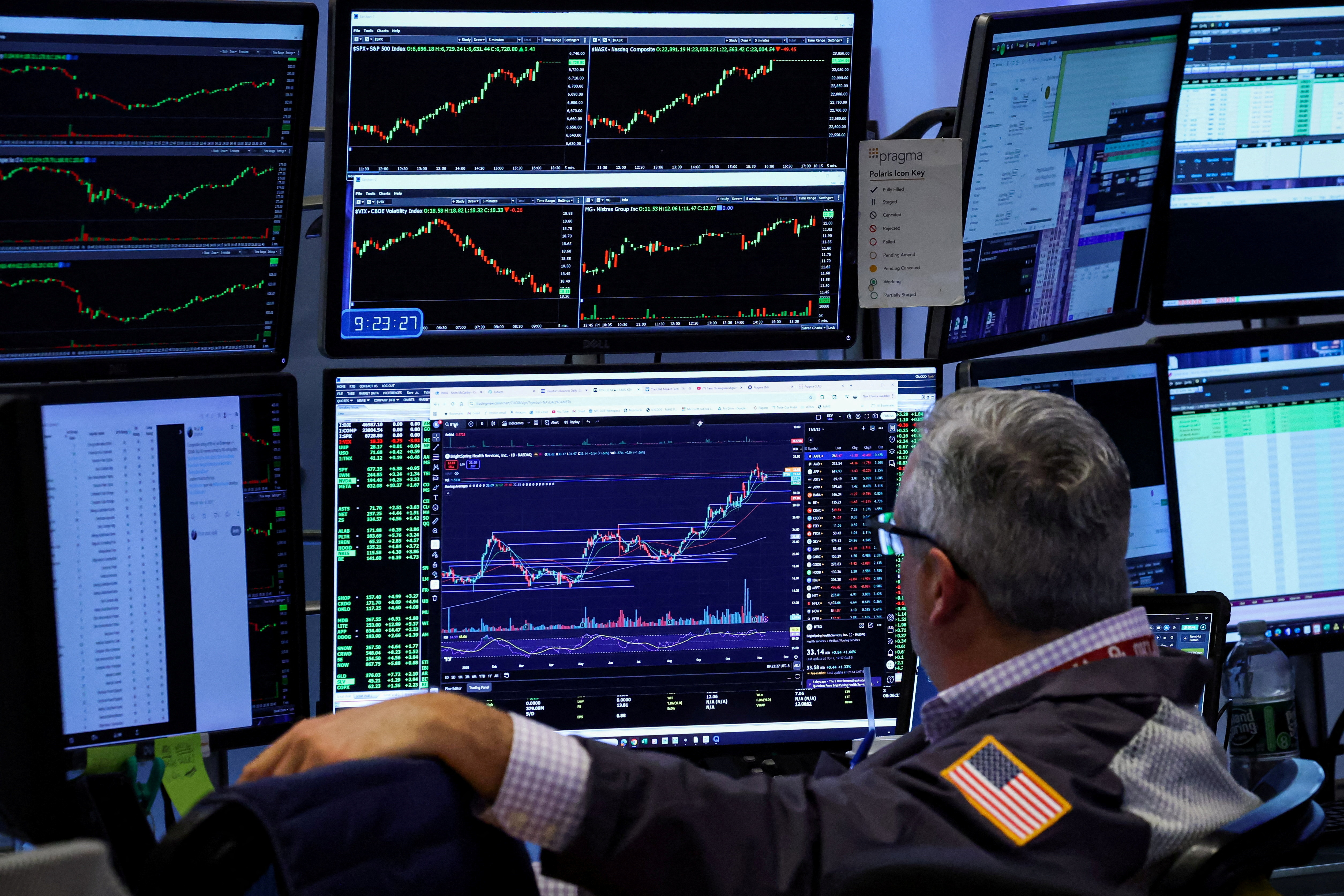
Wall Street's big three indices were little changed on Thursday, while the dollar and Treasury yields rose, after a surprisingly strong U.S. labor market indicator called into question how much lower the Fed will cut interest rates next year.
More on that below. In my column today I look at the U.S. consumer. By some measures, delinquency rates are worryingly high as the affordability crisis bites. But other measures show they are low, leveling off, or even falling. Maybe the glass is half full, not half empty.
If you have more time to read, here are a few articles I recommend to help you make sense of what happened in markets today.
Today's Key Market Moves
Today's Talking Points
* China flexes at FX fix
China's yuan has been on a tear lately, powering to 14-month highs against the dollar and bringing the 7.00/$ level into view. But its impressive rally shouldn't be confused with a willingness in Beijing to let it go unchecked.
On Thursday the PBOC's daily fix was 179 pips weaker than a Reuters estimate - the largest weak-side deviation since the data was available in November 2022. And as Reuters exclusively reported, state-owned banks have been buying dollars but using a different intervention strategy. Beijing is still in the driver's seat.
* The claim game
The number of Americans filing new applications for unemployment benefits fell last week to 191,000, its lowest since September 2022. In contrast to the surprise fall in ADP private sector jobs reported earlier this week, this suggests the labor market is holding up just fine.
This is historic. As economist Phil Suttle notes, it is only the 9th time since 1970 that initial weekly claims have fallen below 200,000. And 191,000 today is a much smaller share of the labor force than it was in the past. Does this look like a labor market in need of more rate cuts?
* The Fed's division bell
Barring an extraordinary upside surprise in the September PCE inflation data on Friday, the Fed will almost certainly cut interest rates again next week. But the division of opinion, and number of dissenting votes, will garner more market attention than the decision itself.
There hasn't been a unanimous FOMC vote since June, and there have been more dissents in 2025 than any year since 1993. The FOMC has not had three or more dissents at a meeting since 2019, and that has happened just nine times since 1990. A 7-5 split next week would make upcoming meetings very interesting, especially with more hawkish regional Fed presidents becoming voters in 2026.
U.S. consumer delinquency glass is half full
Years of high borrowing costs and sticky inflation have spawned an affordability crisis in the United States, but some consumer delinquency figures suggest the economic picture might not be so grim.
Today there is much talk of the so-called "K-shaped" economy: the rich are thriving while the rest are barely surviving. Proponents of this narrative often point to the millions of consumers struggling to service their debts, be they credit card, auto, student, or other loans.
If the labor market continues to weaken, they argue, incomes will be squeezed, delinquencies will accelerate, and economic growth will slow. In a worst-case scenario the economy could tip into outright recession.
With the unemployment rate the highest in four years and rising, this is a compelling argument, especially now that the slowdown in hiring is threatening to flip into outright firing.
And it's true that, by some measures, consumer delinquency rates are "elevated", as the New York Fed notes. But by others, they are either low, or are leveling off from the steady rise that followed the pandemic.
"Household leverage and debt servicing costs remain low by historical standards, and credit card delinquency rates continued to level off through 2025 Q3," Goldman Sachs economist Joseph Briggs wrote on Monday.
Indeed, at the aggregate level, household debt service payments as a percentage of disposable personal income have steadied in recent quarters at just over 11%. That is lower than the level just before the Covid-19 recession, and, more significantly, is also below levels that immediately preceded the three prior recessions going all the way back to 1990.
Combine this with the likelihood of falling interest rates and fiscal stimulus in the coming year, and the outlook for the U.S. consumer - and, by extension, the economy - may be brighter than feared, even at the lower end of the income scale.
Outstanding credit card debt in the United States is around $1.23 trillion, roughly a quarter of the $5.09 trillion of total household debt. And credit card interest rates are among the highest of all borrowing costs, with the average annual rate currently running comfortably above 20%.
Yet credit card delinquencies are falling. At the end of September, the aggregate rate stood at 2.98%, according to Fed data, down from 3.22% in June last year, which was the highest since 2011.
Drilling down, there are even encouraging signs for lower income deciles, says John Silvia, CEO and founder of consultancy Dynamic Economic Strategy. Excluding the top 100 banks that typically cater to wealthier consumers, credit card delinquency rates at the remainder of the roughly 4,000 U.S. commercial banks are below 7%, down from a multi-decade peak near 8% a couple of years ago, he finds.
"Credit card delinquencies are a sensitive indicator of the credit cycle," Silvia says. "From a small bank point of view, there is no immediate problem – steady economic growth, rising home prices and lower two-year (Treasury) yields are all positive."
Importantly, lower interest rates also appear to be on the horizon, with the Federal Reserve likely to resume its easing cycle next week. This will obviously benefit the wealthiest cohorts by further boosting asset prices, but it should also help all borrowers by reducing debt servicing costs to some degree.
Income growth is crucial to keeping a lid on delinquencies, of course, and here the signs are reasonably encouraging, for now at least. According to the Atlanta Fed, average annual nominal wage growth is still above 4% and therefore still positive in real terms.
To be sure, inflation remains elevated, job creation has slowed and one can find compelling counterarguments about the health of the consumer in the reams of debt and delinquency data.
For example, student loan defaults have spiked after the 12-month moratorium on payments expired late last year. These loans total $1.65 trillion, around a third of all non-mortgage household debt, and the burden is getting heavier.
If the labor market sours, the debt picture will certainly darken. But as things currently stand, there are grounds for cautious optimism that U.S. consumers are servicing their debts, and the worst may even be over.
What could move markets tomorrow?
Want to receive Trading Day in your inbox every weekday morning? Sign up for my newsletter here.
Opinions expressed are those of the author. They do not reflect the views of Reuters News, which, under the Trust Principles, is committed to integrity, independence, and freedom from bias.
关注我们